Everything happens so much
and for what??

Nothing to preamble about this week. Many thanks to not sleeping well for the static brain.
A TV Thing: Star Trek Discovery Season 3
(Spoilers for the entirety of Discovery, as you might imagine.)
Some of my earliest blips of memory are related to Star Trek—my mother was an old-school fan of the original series and I was born during the run of The Next Generation. I can remember sitting on her lap in her favorite leather chair while Picard and Geordi and the rest of them faced the crisis of the day. Even though the Enterprise series ran through 2005, Star Trek shows were always something that felt old to me. They were of another time. If we wanted Trek of the now, we would have to rely on the glossy films that reimagined the stories of Kirk and Spock and tried to tell us Khan was white.
In that way, being able to tune in weekly to a new episode of a currently-airing Star Trek series seems like such a privilege. I binged the first two seasons of Discovery over last summer (after getting through most of TOS) with enough time to spare to give that adrenaline rush time to settle. I know the pacing of a Trek show speaks to the television conventions of its time, but the difference between an episode of DS9, TOS, and Discovery is bonkers.
One thing I do like about Discovery is that each season is a clearly planned contained story, much like individual episodes were for TOS and TNG. In a media landscape where shows can get canceled with little warning and no regard for the story, it feels like a smart move.
But there’s a lot about Discovery that is very different from its predecessors. First and foremost, the series lacks a single captain figure. This person changes from season to season, from Lorca in season one to Pike in season two and then Saru in season three. The season three finale then sets up Michael Burnham to be Discovery’s captain in season four. I’ve been struggling to find a narrative reason behind this choice other than some cynical thought that they’re switching things up so modern viewers don’t get bored. The season one bait-and-switch with Lorca, where the captain ends up being an antagonist, was a clever way to subvert longtime Trekkie’s expectations. Pike played on TOS nostalgia (along with a younger bearded Spock) and opened up the path for that spinoff series. When Saru got the helm in season three, I really hoped he would keep it! One of my little pet peeves about SFF as a genre is how human-centric it can be in words with a multitude of sapient peoples: why shouldn’t a non-human get to captain a show’s central vessel? Given his arc from serving on prime!Georgiou’s bridge to living through Vahar’ai—literally overcoming his innate fear by shedding his body’s organs for it—becoming captain simply felt right. What is braver, after all, than captaining a star ship 900 years away from everything you’ve ever known?
Michael taking the captain’s chair was inevitable, though, just because of what Discovery is as a show. And don’t get me wrong—I love Michael. I think she’s a fantastically complex character whose background and motivations add so much to the Star Trek universe. But Discovery’s narrative is focused on her to a degree that I find odd for the franchise as it’s grown to be. DS9’s series premiere and finale both had a heavy emphasis on Ben Sisko, the station’s captain, but in the show’s seven-season run, there were episode plots he wasn’t involved in. The ensemble cast featured around nine or ten characters, and each of them was allowed the narrative space to be complex individuals with their own separate arcs. Discovery’s recurring cast is larger, but there is so much attention on Michael that only a handful of other characters on the ship are allowed to be multi-dimensional, much less have satisfying arcs. So I want to know more about Owo and Detmer and Bryce and Rhys and Linus! So sue me!
Star Trek to me has represented a vision of the future that emphasized the good that can come when we recognize the power of the collective, of cooperation. In the other series I’ve seen, Kirk and Picard and Sisko are not the main driving forces of their shows’ plots. Other characters are allowed to take the lead or the spotlight, while Discovery so heavily invests in a single person. Such stark individualism feels antithetical to what Star Trek is about. Why is one person at the center of solving all of these dire crises when this supposed idyllic concept of the future relies on disparate alien cultures and peoples coming together for their common good? I have plenty of cynical answers to this question. Pouring all your effort into writing one very good character is easier than meting out that level of attention across an entire cast. Or maybe the hellscape of late-stage capitalism has mutated so much since the era of TNG/DS9 that we can’t have any semblance of the socialist money-less society Earth and the Federation had become, even in the narrative structure of the show. After all, Discovery has jumped into a future where the Federation fell apart and 32nd-century takes on capitalism run rampant. The problem is the same that we face in reality, but the optimistic alternative of earlier series has been disappeared.
All this sounds like I don’t like the show—I do! I wouldn’t have paid the monthly subscription fee if I didn’t! I just have thoughts, you know? This season I was thrilled that they were introducing trans characters on the show, Adira and Gray. And while it’s never explicitly said that Gray is a trans man, Adira does take the time after being featured in a number of episodes to clarify their pronouns. It’s a nice moment for television in the 2020s, even if that character fails to assert their identity and is so uncomfortable about it when they do, even when they were born in the 32nd century. You’re telling me over a millennium has passed and the change is that subtle? Of course the portrayals of the future are limited by the imaginations and mores of the time it’s written in. But god, if I got blasted to 3021 and saw someone be like, “so, uh, just so you know, if you don’t mind, I use they/them, and this is what that means,” I would walk right out of the nearest airlock.
At any rate: Discovery S3’s MVPs are her majesty Grudge, Adira and Gray, Saru, and Book. The last two episodes really got me with Stamets—back in college, I got really into a couple procedural shows that weren’t ever invested in long-term consequences of their plot points, and seeing Stamets’ reactions be informed by his losses and trauma in earlier seasons still feels like a treat. It’s a basic example of decent writing, but I’m thankful all the same.
An Internet Hole Thing: Huttese
I know not every fictional constructed language can be like Klingon. I know Star Trek, more so than Star Wars, attracts the kind of nerd who not only wants to but can pull a new language into thin air.
That being said, I have questions about Huttese.
I found a pretty nice glossary of Huttese on a cursory google—I’m currently playing a Hutt in an Edge of the Empire campaign, and while he speaks accented Basic, I thought it would help flesh out his character if there were some Huttese words or phrases at the back of my head. Unnecessary? Probably. But my original conception for/depiction of this Hutt in 2019 had him speaking a good amount of Huttese, so it was bothering me.
Anyway—
That glossary had a wider variety of words than I expected, everything from general pronouns and verbs to vocabulary for the illicit trade deal of the hour. The issue with a glossary, though, is that it offers little to no insight into the language’s actual grammar or syntax. The glossary’s author has, on another page, clearly put much more thought into this than anyone at LucasFilm.
Still.
Let me conjugate a verb. Give me a sign. Explain to me how “I want” translates to oto but the infinitive is naga. “Is” by itself is sa, but “it is” becomes soong, “he is” becomes hees and “I am” is dobrah. Other verbs don’t get the same treatment, like tinka (“think”), used as-is in a line pulled from Episode I—so are “be” and “want” irregular? Negations are a whole other story. Hagwa is “do not” but none of the translations for “no” or “not” resemble anything in that word. Just tell me how to do it! End my troubles! I mean, the year of Arabic I took in college to finish out my degree was full of troubles, but it had rules.
Grammar aside, there are some fun quirks of individual words in Huttese. There’s some that are a form of direct cognate with English (tee-tocky for time, lickmoomoo for dessert, whirlee for dancers). Others make sense in the scope of Hutt culture as a whole—no words exist for “please” or “thank you,” for example. My personal favorite are the Huttese for “big” and “big-time”: porko and porkman, respectively, which seem like references to their traditional Gamorrean guards.
And I know the linguistic/anthropological theory about language being an indication of culture in the real world has tons of issues, but… this is Star Wars. No one, as I said before, thought anywhere that hard about this. Meendeeya da nobatayuna tinka.
A Brainworms Thing: MAG190 - Scavengers
(Spoilers, obviously.)
It’s officially the beginning of the end! Help!
I’d been on my theory about Georgie and Melanie not being affected by The Eye for so long I forgot that it wasn’t technically canon, right up until Melanie explicitly laid it out exactly as I’d guessed. What I didn’t expect was how explicitly they’re depicted as the anti-Jon-and-Martin—
the archivist who sees all with a favorite of The Beholder VS someone who’s severed from The Beholder by blinding herself with someone the Entities can’t terrorize
Jon’s only way of helping regular people stuck in pockets of horror is by turning them into monsters themselves VS Georgie and Melanie being able to pluck them out and take them to the tunnels and relative safety
Jon’s powers feeding on fear VS Arun’s theory that Georgie and Melanie’s ability to safely navigate the apocalypse feeds on hope, even if it’s not technically true
also just the physicality of Georgie and Melanie spending most of season five underground when that’s never been necessary for Jon and Martin
I’ve been wondering how much hope was going to play into the ending of the story—obviously The Magnus Archives is a horror podcast, obviously the narrative is trending more towards tragedy, but it’s also a story about reckoning with a world full of evils and having to exist within it. You have to have hope that another world is possible, even if you can’t see the path to it, because what is the point otherwise?—which is why Melanie claimed she had a vision of the apocalypse ending at all.
Heading into the last ten episodes, I can’t help but keep this blurb about tragedy as a genre at the back of my head (taken from here):
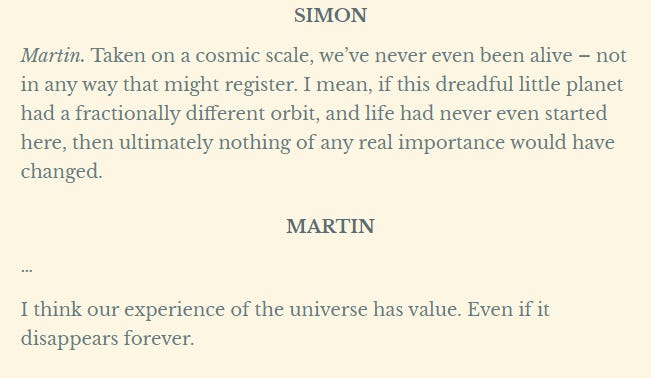
I once heard a lecture where someone said that the great appeal of tragedy is to see terrible things happen to people you’re supposed to empathize with and see yourself in, and that the catharsis comes from seeing someone’s life go horribly wrong and still have the author hold your hand and tell you, “This story mattered. Even though it had a sad ending, it still mattered. Even if you don’t succeed your attempts matter.” Grimdark tells you that the world sucks and nothing you do matters. Well-written tragedy tells you that sometimes the world sucks but everything you do matters so so much. Your story is still worth telling even if you never achieve that happy ending, or if you lose it along the way. People have inherent value and their stories deserve to be told no matter if they turn out okay or not, and in a reality that has no concept of “fair” that shit just hits good man!!! Feels good!!!!! It’s COMFORTING.
MAG151 says about the same thing, too:
An Olive Thing

OKAY so it's so interesting to hear you talk about Discovery because as we know, I started a venture into watching TOS last year (and am hoping to continue it more this year, but I'm so lazy...) and my biggest gripe always is the limits of the utopian imagination (I blame Gene in a way that SW fans blame George, but the latter is more fair maybe.) The whole episode about prison and 1) THERE ARE PRISONS IN THE FUTURE?? YOU'RE TELLING ME WE STILL HAVE PRISONS IN OUR UTOPIAN FUTURE??? GENE I'M GONNA FIGHT YOU and 2) the end of that episode ISN'T "all prisons are bad and there should never be prisons"
I think ultimately where I'm going with this is the weird confluence of a utopian imagination that is ultimately for consumption. Obviously having Adira restate their pronouns is like for Cis People, but like. Is that a trans utopian future we're looking at? No. A trans utopian future is one where I can change my body on a whim and everyone automatically knows my pronouns without me saying them, or one where I'm not perceived at all. And in 1966, there were absolutely people who were pushing against prisons and the concept of criminalization (Tantalus V is for the "criminally insane," which fails to undo criminality or even interrogate it as a category) but it's a fairly mainstream TV show that doesn't have a writer's room that includes incarcerated and formerly incarcerated Black folks who are articulating opposition to prisons and criminality altogether (though it would be SO DOPE if it did.)
And I don't know exactly where I'm going with this except to say that our mainstreamed/cultural utopias seem to do way more work in highlighting the limits of a mainstreamed (/presumed white) imagination, and so what are the challenges of speculative fiction if we intend to pursue these other worlds (which I think we should! Dystopia is interesting insofar as it's about surviving, but we also need to imagine a world to work TOWARDS, where we can concern ourselves with thriving.)